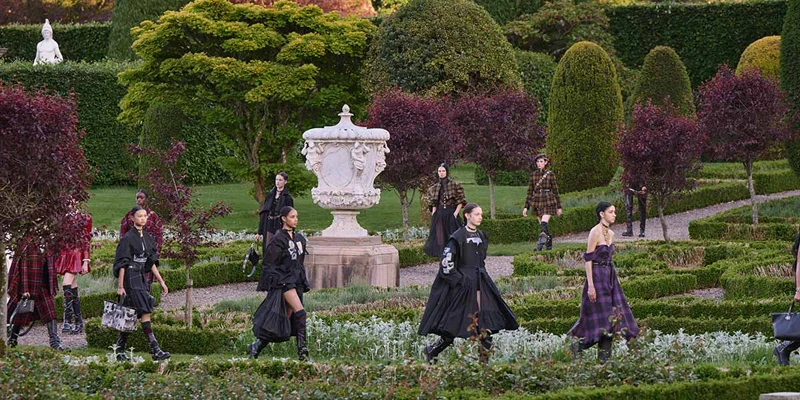
Imagine the mist-shrouded terraces of a 19th-century Scottish castle, where the air hums with the skirl of bagpipes and the scent of wild herbs mingles with the rustle of silk. It’s June 2024, and beneath the ancient stone walls of Drummond Castle in Perthshire, a procession of models glides down garden paths lined with thousands of blooming perennials. This wasn’t just a fashion show; it was a living tapestry weaving together centuries of Scottish heritage and French elegance, all under the creative vision of landscape designers Susan Begg and Nicola Semple. In an era where fashion increasingly borrows from nature to stage its grand narratives, the Dior Cruise 2025 collection marked a poignant return to Scotland for the iconic house.
Christian Dior himself had showcased collections there in 1951 and 1955, drawing inspiration from the rugged beauty and textile traditions of the Highlands. Nearly 70 years later, creative director Maria Grazia Chiuri—whose tenure at Dior spanned from 2016 until June 2025—revived this legacy. Her designs paid homage to Mary, Queen of Scots, blending tartan, tweed, and bespoke kilts crafted with Scottish artisans like Harris Tweed, Johnstons of Elgin, and designer Samantha McCoach of Le Kilt. The result was a fusion of haute couture and cultural storytelling, amplified by a bespoke planting scheme that transformed the castle’s 9-acre historic gardens into an immersive runway.
The Art of Botanical Backdrops in Fashion
Fashion’s flirtation with horticulture has deep roots, echoing the opulent gardens of Versailles that once influenced royal wardrobes. In recent years, this trend has flourished: Hermès conjured a meadow-like runway at Paris Fashion Week 2024, designed by Luciano Giubbilei, while Gucci’s Cruise 2025 show at the Tate Modern featured a woodland installation by Cargill Sykes, Bureau Betak, and Form Plants. For Dior, Semple Begg Studio—longtime collaborators Begg and Semple—were tasked with creating a temporary botanical intervention using nearly 10,000 plants. Their goal? To mirror the collection’s themes of drama, narrative, and symbolism without overpowering the historic landscape. The duo drew on Scotland’s Stuart dynasty ties to the French court, referencing the exiled court’s time at Saint-Germain-en-Laye near Versailles. Yet, they avoided rigid historical recreations, opting instead for a seamless blend of past and present.
“Our role was to support Maria Grazia Chiuri… She’s a phenomenal designer, known for designing collections that are deep Look at the historical, cultural and craft traditions of the country in which she chooses to stage her cruise collection,” explained Begg. “We began by exploring the horticultural links between the Stuart dynasty and the French court.”
The planting appeared effortlessly integrated, as if the flowers had always belonged.
“The garden should look as though our plants had grown in situ. Our work should go unnoticed,” Begg added.
Crafting the Design Amid Secrecy and Scale
The project unfolded in real time, synchronized with the evolving collection in Paris. Semple Begg exchanged precedent images, visualizations, and feedback iteratively, balancing artistic intent with practical constraints like budget and timelines.
- Key challenges: The design had to evolve confidentially, with final planting lists confirmed just six weeks before installation—far shorter than the typical eight to nine months for a major garden show.
- Visual priorities: Focus on sightlines from guest seating along the castle steps and parterre axis, ensuring readability for close-up views, press cameras, livestreams, and drones.
- Scale of installation: Shrubs, perennials, and climbers concealed a three-story backstage area (comparable to an RHS Chelsea Flower Show garden) while softening the castle’s fortress-like facade for a welcoming arrival.
- Temporary elements: Bespoke photo-call backdrops, inspired by artist Pietro Ruffo’s toile de Jouy patterns, were added days before the event.
“We couldn’t have achieved it without Dave Root and the Kelways team. His contribution was extraordinary,” Begg noted.
Harmonizing Heritage with Horticultural Innovation
Drummond Castle’s Renaissance parterre, typically featuring lavender and annuals tied to the Drummond family crest, underwent subtle reimagining. With lavender not yet in bloom, the central borders gained structural shrubs and dense perennials potted at 12–15 plants per square meter. Where boxwood blight marred the hedges, large Nepeta specimens masked the damage while boosting visual impact. Standouts included twisted stems of Dipsacus fullonum (teasel) and vibrant Campanula ‘Sarastro’ borders, evoking the wild Scottish countryside. Post-show, all elements were meticulously removed, restoring the original lavender planting to preserve the site’s listed status.
This careful stewardship highlights a broader societal shift: high-profile events like this spotlight sustainable practices in landscape design, blending spectacle with respect for heritage sites. No major uncertainties arise in the documented process, though exact plant quantities beyond the 10,000 total remain approximate based on installation scale. As fashion continues to intersect with environmental storytelling, collaborations like Semple Begg’s could redefine how we experience cultural landmarks. What might this mean for the future of ephemeral gardens in global events—temporary wonders that educate on heritage while urging sustainable innovation?